
Choose a Livermore Search Route
The best starting point depends on what is already known. A full name can lead to Alameda court cases, recorded documents, licenses, business filings, or current government staff listings. An address is more useful in the Assessor Property Search and Livermore permit system. An old family name belongs first in obituary, newspaper, church, cemetery, and probate sources. Phone numbers are less useful in official records because most agencies publish office numbers, not private contact data.
Keep each result tied to its keeper. An index entry points to a source record; it is not the same as a certified copy. Similar names also need a second fact, such as a middle initial, parcel, filing date, case number, or known relative.
- Write down the name, place, date range, or address already known.
- Choose the city, county, court, state, or history collection that keeps that fact.
- Search the official index with the narrowest reliable terms.
- Compare the result with a second official or historical source.
- Use the counter, mail process, library, archive, or records request when the web trail ends.
Livermore Search Offices by Keeper
Livermore City Hall holds municipal records, but the durable identity trail is mostly county-run. Alameda County keeps recorded deeds, vital certificates, parcel data, court cases, voter files, and jail information. Oakland is the county seat, while some court services are available at the East County Hall of Justice in Dublin. The complete access and copy procedures belong with the Livermore public records system.
Alameda County Clerk-Recorder
1106 Madison Street
Oakland, CA 94607
(510) 272-6362
Alameda County Assessor
Countywide parcel records
Alameda County, CA
Address and APN search
Livermore City Clerk
1052 South Livermore Avenue
Livermore, CA 94550
(925) 960-4200
Livermore Recorder Search Cutoff
The Alameda County Clerk-Recorder provides the main name trail for deeds, liens, fictitious business names, and other recorded instruments. Its electronic official-records index begins in 1969. Earlier documents must be searched in person. County references place the official record series back in the county's formation era, and FamilySearch provides an additional Alameda land-record collection covering 1853 through 1920.
The Official Public Records entry page leads into the county index. It is useful for finding whether a document exists, while copy orders and counter research supply the record itself.
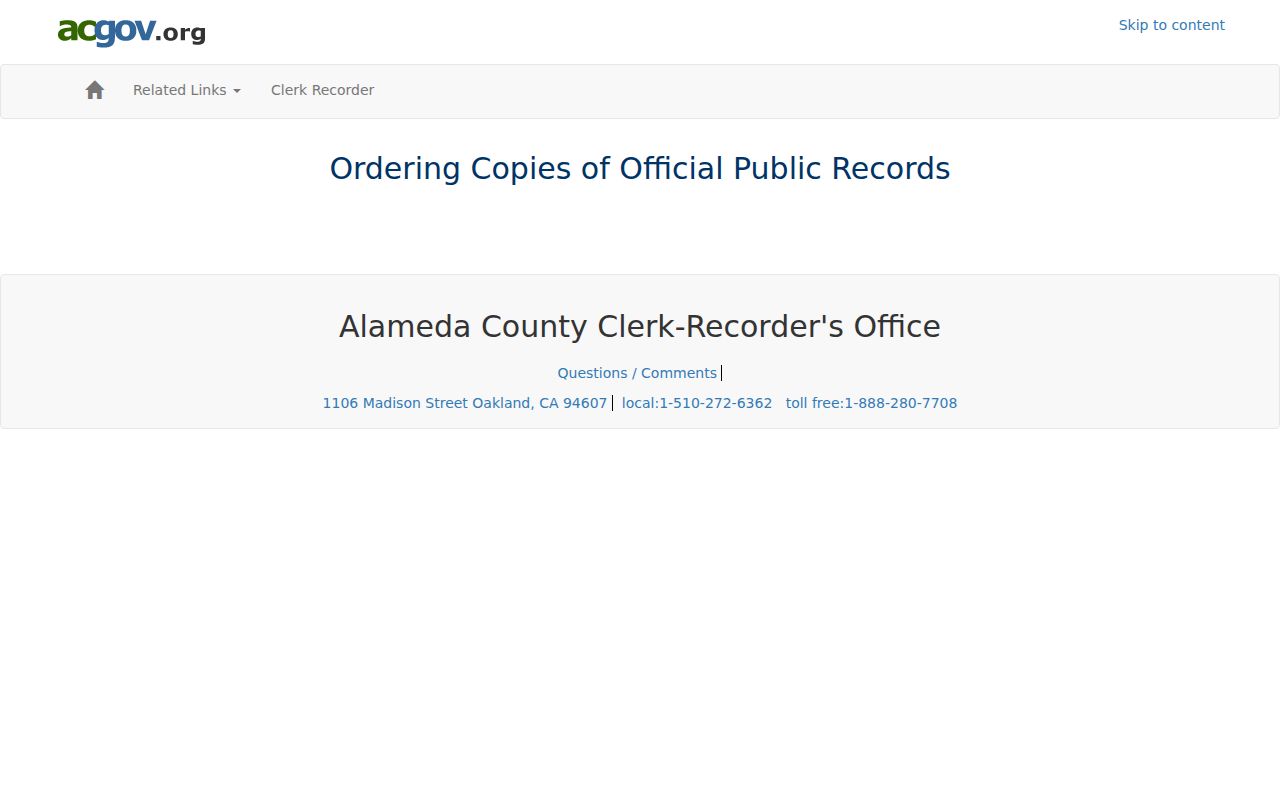
The portal screen marks the point where a Livermore name search moves from general county instructions into the recorded-document system.
- Index
- A list that identifies a filed record and helps locate it.
- Grantor
- The party transferring an interest in a recorded document.
- Grantee
- The party receiving the recorded interest.
- Certified copy
- An official copy authenticated by the record keeper.
Note: Treat 1969 as an access cutoff, not the year Alameda County began keeping recorded documents.
Trace Livermore Addresses Through Records
An address-based search begins with the Assessor Property Search. Its visible screen accepts an Assessor Parcel Number, a type-ahead address, or a property address. The public landing page does not show an owner-name field. Once the parcel is known, the Parcel Viewer supplies map context, the Treasurer-Tax Collector portal adds tax-account context, and the Recorder index connects recorded parties to deeds and liens. Livermore's Accela permit portal can then reveal projects tied to the site address, parcel, record information, or contractor license.
The Alameda County Assessor Property Search is the official address and parcel starting point.
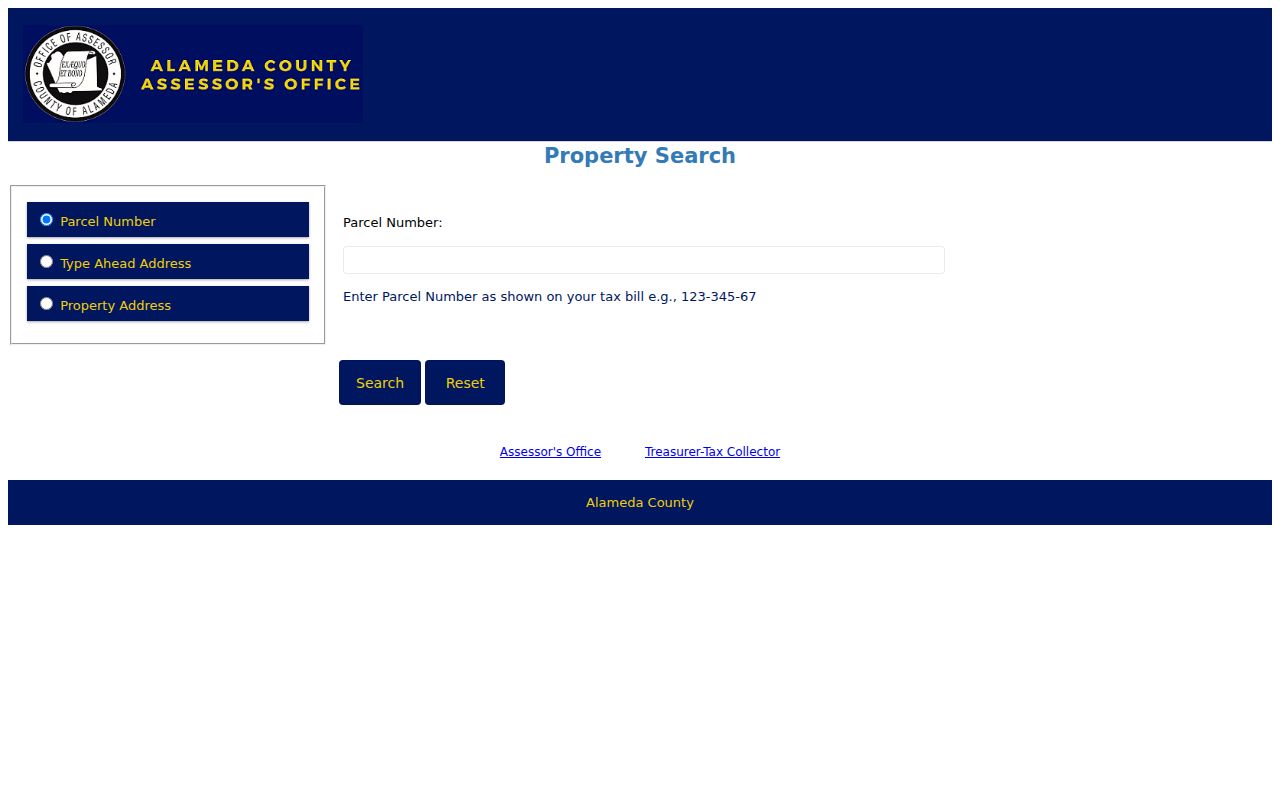
Its search choices show why an exact address or APN is more dependable here than a person-name guess.
| Search field | Best use | Format note |
|---|---|---|
| APN | One known parcel | County example: 123-345-67 |
| Type-ahead address | Select a suggested site | Choose from matches |
| Property address | Street-based lookup | Use the situs, or site, address |
Navigate Livermore Court Record Searches
Alameda Superior Court divides public access by case type. eCourt covers civil, family law, and probate case information, while Odyssey handles criminal case information. eCourt requires an account for its functions and offers name, calendar, case-number, and public-filing searches. Criminal web results are limited to case information for matters with activity since 2005, not document images. In-person public terminals can provide broader access to public documents, including information for many criminal cases opened since 1974.
The court's public portals page is the safest routing screen because it separates eCourt, Odyssey, traffic, and filing searches.
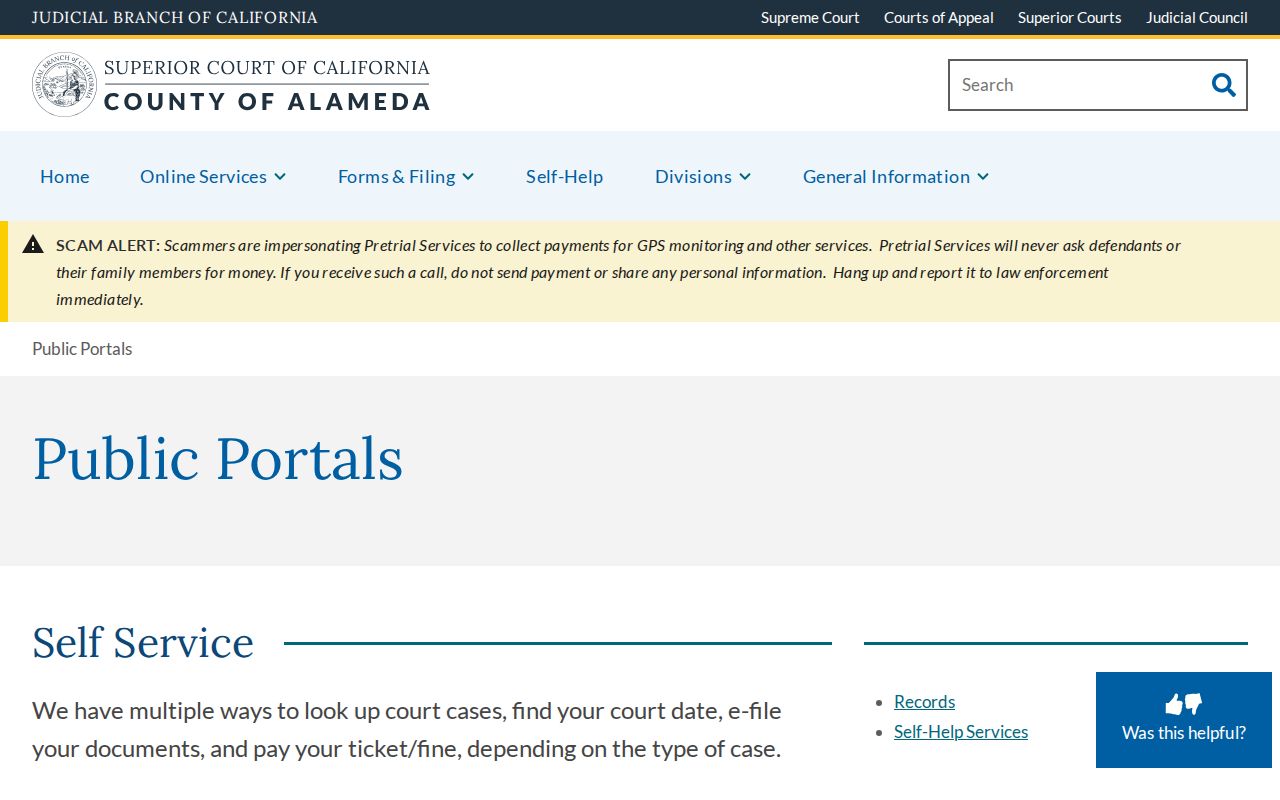
The displayed portal list helps prevent a civil name search from being mistaken for a complete criminal or traffic search.
| Channel | Record scope | What to expect |
|---|---|---|
| eCourt | Civil, family, probate | Case and party search; some fee-based images |
| Odyssey | Criminal | Case information; portal terms may require registration |
| Public terminal | Public court files | No-cost on-site research; files remain on site |
| Mail request | Division-specific records | Use when online access is missing or unsuitable |
Order Livermore Vital Records Correctly
Alameda County Clerk-Recorder issues birth, death, and marriage certificates for events within the county. California Department of Public Health Vital Records maintains statewide birth, death, fetal death or stillbirth, marriage, and divorce records. California Health and Safety Code section 103526 separates authorized certified copies from informational certified copies. An authorized copy requires an eligible relationship or status and a sworn statement. An informational copy carries a legend stating it is not valid to establish identity.
County fees are $36 for a birth certificate, $28 for a death certificate, and $21 for a marriage certificate. The county marriage page says filed certificates generally become available after two weeks and that it has no marriage certificates before 1854. For older family research, use the State Archives, FamilySearch, local obituaries, church records, and cemetery sources instead of assuming a modern certificate portal is a name directory.
Check Livermore Voter Status Privately
California's voter status tool is for checking one's own registration, not browsing neighbors. The broader voter file is restricted under Elections Code sections 2188 and 2194 and requires an application for an approved election, scholarly, journalistic, political, or governmental purpose. Driver license and state ID numbers, the last four digits of a Social Security number, signatures, unique identifiers, and confidential-voter records are excluded.
The California voter registration gateway links registration and status functions and warns Safe at Home participants not to use the standard public form.
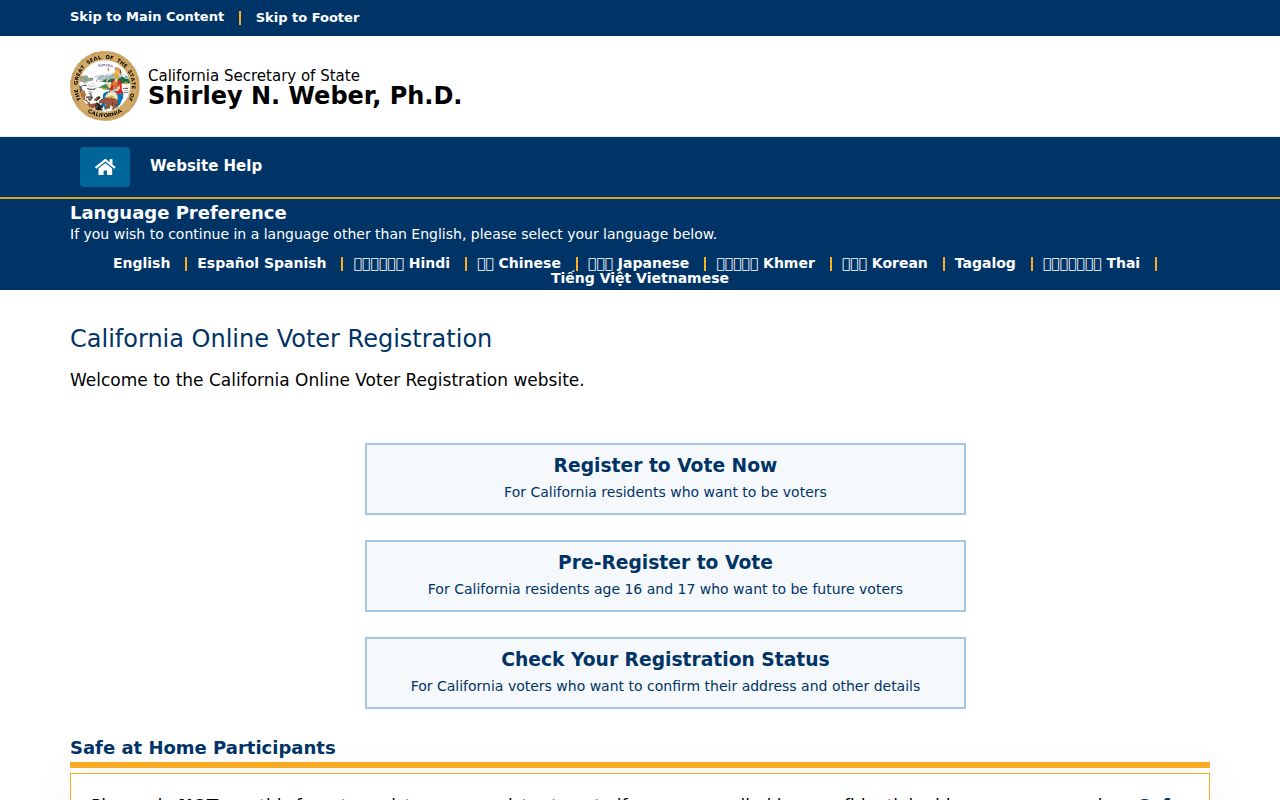
The warning is a useful reminder that a voter lookup should confirm personal civic information without exposing another voter's protected address.
Use records lawfully. Never use a Livermore record or directory to stalk, harass, threaten, or harm a person. Restricted voter and registry data carry their own statutory limits.
Full eligibility, request, fee, and confidentiality rules are covered with Livermore voter registration records.
Search Livermore Civic Records Since 1876
Livermore's own records repository reaches back to the city's incorporation year. City Council minutes and ordinances run from 1876 to current. Resolutions begin in 1944, Redevelopment Agency minutes in 1981, agenda packets in 2000, and summary agendas in 2003. These records can identify officials, applicants, speakers, property owners, claimants, and committee members who took part in local public business.
Laserfiche supports folder browsing or a single-word or phrase search. Scanned documents can be converted to PDF, but the city caps each conversion at 75 pages. A longer document is split into several PDFs. When the repository does not contain the needed file, Livermore's GovQA Public Records Center accepts requests and exposes archive and reference-number searches.
Note: A meeting record is strongest when its date, body, agenda item, and named participant all match.
Place Livermore Custody Searches Carefully
Law-enforcement records use separate systems. Livermore Police handles local reports and calls-for-service requests through its records channels. The Alameda County Sheriff's Inmate Locator searches current county custody by Personal File Number or by both first and last name. California's CIRIS system covers people currently in state prison custody, while the federal Bureau of Prisons locator reaches federal custody records from 1982 forward.
California's Megan's Law search gateway is a public-safety registry with strict disclosure and misuse limits.
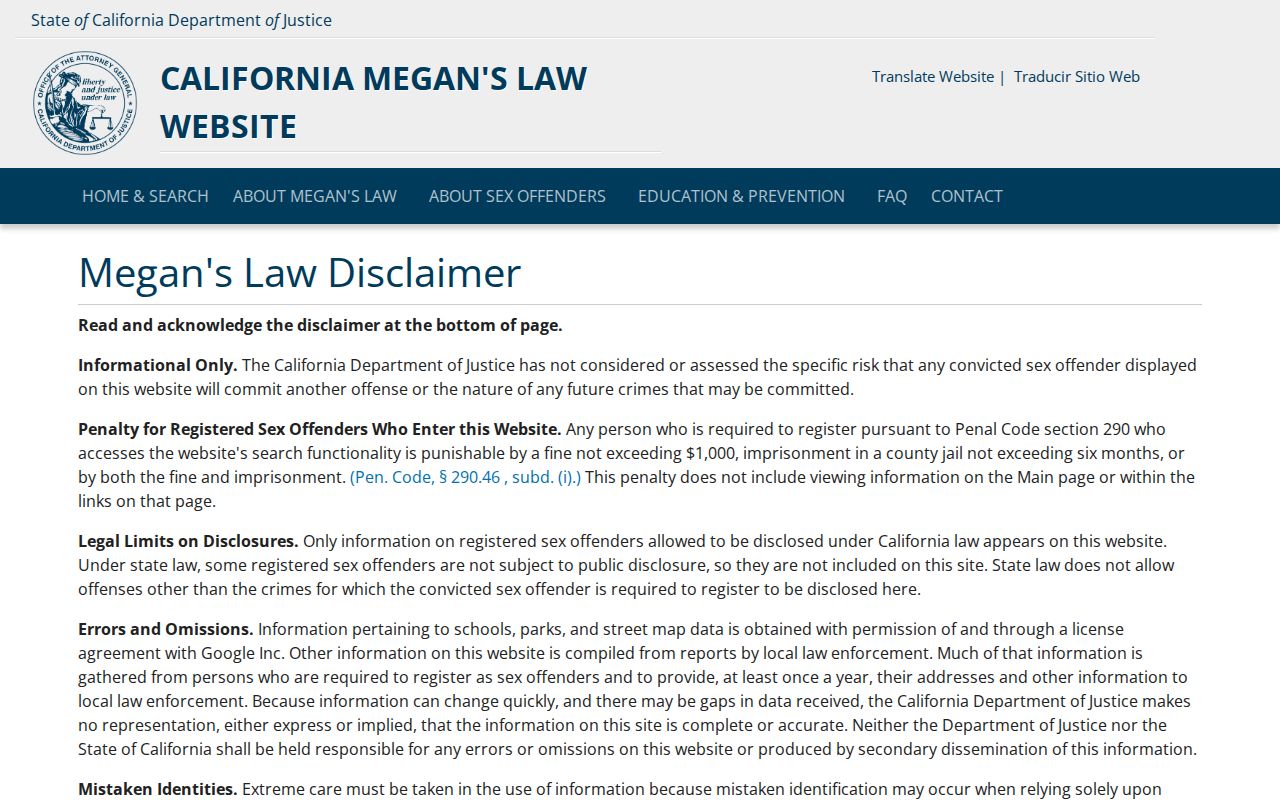
The gateway's warning matters: not every registrant is publicly disclosed, facts can change, and mistaken identity is possible. Verify identity and use the data only for lawful public-safety purposes.
Unlock Livermore Historical Name Records
The Barbara S. Bunshah Selective Subject Index is one of Livermore's best local name tools. It covers Enterprise, The Independent, Livermore Herald, Herald and News, and Tri-Valley Herald material from 1899 through 2002. The PDFs are indexes, not full articles. After finding a name or topic, retrieve the cited newspaper on microfilm at the Civic Center Library.
Livermore-Amador Genealogical Society adds obituary, cemetery, and church indexes for Eastern Alameda County. Its early Livermore obituary publication includes 1,715 people who died before 1906. The Livermore Heritage Guild History Center adds old maps, tax records, business directories, newspapers, photographs, and volunteer indexes. Together, these sources can connect a ranch, business, church, or former address to a family when modern web records stop.
For a long search, move from index entry to microfilm image, then compare the article with a deed, probate file, church record, or cemetery entry.
Find Livermore Business Name Records
California's bizfile Online searches business entities and related filings. The Department of Consumer Affairs advanced license search accepts first name, last name, license number, business name, registry number, board or bureau, and license type. Alameda County fictitious business name filings add local trade names and proprietors, while Livermore Accela links addresses, parcel numbers, records, and contractor-license details to city permits.
These sources answer different questions. Bizfile can identify an entity and its filed agents or managers. DCA can show a regulated license and status. A county fictitious business name can connect a trade name with a local filer. A city permit can tie a contractor or applicant to work at a Livermore site. No one system is a complete business-owner directory.
Browse Livermore Staff Directory Records
The City of Livermore staff directory is a current public-contact source, not a private resident list. Its entries show a staff or office name, title, department, direct phone when supplied, and an email link for many records. It includes named officials as well as functions such as City Clerk's Office, Police Records, Dispatch Center, Engineering, Permit Center, Planning, and Public Works. The library version displayed 90 entries with pagination when researched.
A directory result works best for identifying the official or department responsible for a city service. It does not provide home addresses or private contact data. Search by the person's name when known, or scan the department and office labels when the goal is to locate the right custodian. Historical officeholders belong in council minutes, resolutions, campaign disclosures, and newspaper indexes rather than the current roster.
Check Livermore Unclaimed Property Names
California's State Controller maintains the official unclaimed property search. A Livermore name may appear when a business or institution has transferred dormant funds or other reportable property to the state. This can supply a name-and-address lead for reconnecting with a relative or tracing an estate, but a possible match does not establish identity by itself.
Compare the reported name and location with known records before starting a claim. Use the Controller's own search and claim process instead of paying a solicitation simply because it mentions unclaimed funds. A probate case, obituary, deed, or historical directory may provide the second fact needed to separate people who share a name.
Continue a Livermore Search Offline
Online coverage has hard edges. Recorded documents before 1969 require Clerk-Recorder counter research. Alameda court terminals may show public documents that are not available through the web portals. Bunshah newspaper results lead to library microfilm, and the Heritage Guild keeps maps, tax material, directories, and newspaper files that have no single online search box. Mail is also a valid channel for recorder copies and division-specific court research.
For a city file absent from Laserfiche, Livermore's Public Records Center accepts California Public Records Act requests, subpoena requests, and reference-number searches. Government Code section 7922.535 gives an agency 10 days to determine whether a request seeks disclosable records it possesses. A written extension of no more than 14 days may apply in unusual circumstances. That deadline is a decision notice, not a promise that every responsive file will be produced within 10 days.
Describe the record, date range, department, people, address, and known filing or case number as narrowly as possible. Ask to inspect records when copies are not needed. If an agency cites an exemption, request the non-exempt portions and the legal reason for withholding the rest.
Compare Livermore Search Sources
Official records and commercial people-finder products are not interchangeable. Commercial services combine public files, marketing data, phone and address histories, and scraped material. The results may be quick, but they can be stale, merge people with similar names, or charge for a report whose original source is free. An official index takes more care yet shows which office created the record and how to request the underlying file.
| Source | Strength | Limit |
|---|---|---|
| Official portal | Traceable keeper and defined record set | May omit old, sealed, or offline files |
| Library or archive | Historical newspapers, maps, directories | May require microfilm or on-site work |
| Commercial compilation | Fast cross-source hints | May be stale, mixed, or unsourced |
Verify Livermore Property Record Alerts
Alameda County's Real Estate Fraud Notification Letter program turns a recorded-document event into an owner alert. The District Attorney's fiscal-year 2024-25 report says the program began in 2023 and sends more than 5,000 notices per month. The county has also warned about false sellers, forged deeds, urgent below-market offers, and schemes aimed at vacant land or residential property.
A notice is a prompt to verify, not proof by itself. Compare the filing through the Clerk-Recorder, review the first page sent by the county, and contact the District Attorney's Real Estate Fraud Unit if the record appears false. The Assessor also points owners toward property-fraud alert resources. This final check keeps a Livermore name-and-property trail focused on consumer safety and the original custodian record.