
Check Livermore Voter Registration
Begin with the California Secretary of State voter status lookup when checking your own Livermore registration. The state registration gateway describes this as the place for voters to confirm their address and other details. It is an identity-based self-service check, not a way to browse names across Livermore or Alameda County. The captured research could not extract the form's exact identity-field labels, so the table below distinguishes what the official pages confirm from what remains unverified.
| Lookup component | Control | Required | What the capture confirms |
|---|---|---|---|
| Check Your Registration Status | Portal action | Yes | The state gateway sends a voter to the status tool to confirm address and registration details. |
| Identity fields | Web form | Yes | Exact labels were not captured. Enter only the personal details the live official form requests. |
| Safe at Home notice | Privacy warning | Not applicable | Confidential-address participants should follow their program's protected process instead of the public registration form. |
Open the state tool, supply the requested identity details, and review the returned personal status. If the check does not resolve a Livermore registration issue, use the Alameda County registration channel, which routes residents to the California system. Questions about an authorized data request belong with the Secretary of State or county elections office, not the self-lookup.
The official California lookup screen shows the proper starting point for a Livermore voter.
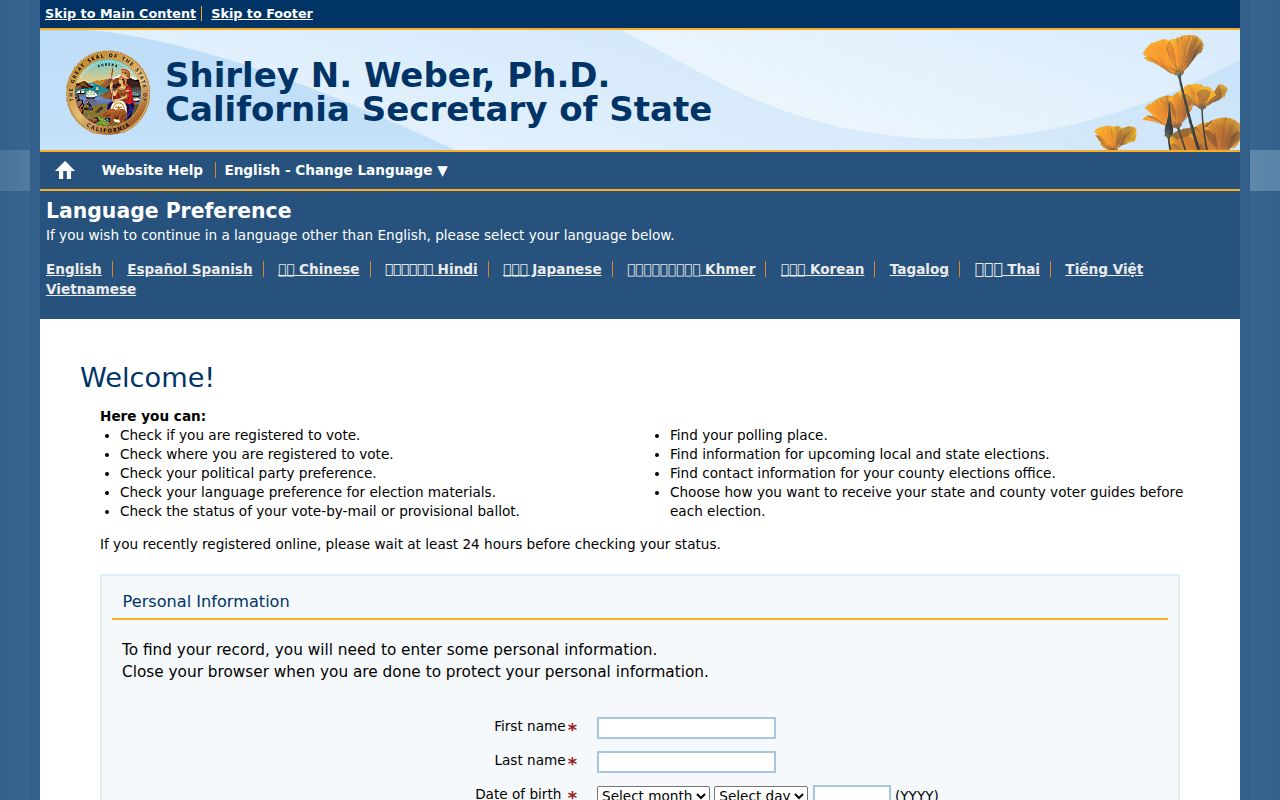
Its official status-check purpose reinforces the boundary between confirming your own record and requesting restricted voter data.
Livermore Status Lookup Limits
California voter registration information is not public data in the casual sense. That point matters because an official status page can look like a general search portal. It is not. The status tool lets an individual check a personal record, while the statewide or county voter file requires an application, an approved purpose, identity documentation, payment, and data-security promises.
A request under the California Public Records Act does not bypass those election-specific rules. Government Code section 7924.000, Elections Code sections 2188, 2194, and 18109, and California Code of Regulations sections 19001 through 19013 control this record set. General agency-record procedure is treated separately in Livermore public records access.
Myth: A voter status tool is not an open Livermore voter directory. Broader access depends on statutory approval and an exact stated use.
Note: Never use the status lookup to test another person's identity details or to defeat a confidential-address protection.
Livermore Voter Record Fields
An approved California voter file can include core registration data for non-confidential voters in Livermore. The precise delivery depends on the request and approval. Voting history means whether a person took part in an election; it never reveals ballot choices. Inactive records are an optional request item, and precinct-to-district information can be requested as a separate data component.
| Name | Included for a non-confidential voter when the request is approved. |
|---|---|
| Residence address | Used to identify a specific record and may appear in an authorized file, subject to confidentiality. |
| Mailing address | May be present, but protected or confidential status can suppress it. |
| Party preference | May be included; county aggregate data also reports California party categories. |
| Registration status | Active or inactive data can be requested. The research does not support promising every status label. |
| Voting history | Optional participation history, never a person's selections on a ballot. |
| Precinct and districts | Optional district data can connect a record with election geography. |
Date of birth helps identify a specific voter on an application. The research does not establish how a full birth date appears in a delivered file, so it should not be assumed to be a generally released field.
Confidential Livermore Voter Data
Some data never enters the released file. Elections Code section 2194(b) excludes a California driver license number, state identification number, the last four Social Security number digits, the unique voter identifier, and the signature or digitized signature image. Pre-registration records for people who are 16 or 17 are also withheld because those minors are not treated as registered until age 18.
Confidential by law. Voters protected under Elections Code sections 2166, 2166.5, 2166.7, and 2166.8 are excluded from released voter registration files, along with the identifiers listed in section 2194(b).
California's Safe at Home program provides a confidential-address process. Its participants should not use the public online registration or re-registration form. They can contact Safe at Home at (877) 322-5227 for the protected procedure. A special path in Elections Code section 2166.9 concerns certain elected-official or candidate contact information for bona fide journalistic or governmental purposes, but it does not open all confidential data.
Request a California Voter File
The Secretary of State voter-file request page identifies who may apply. Categories include candidates for public office, qualified initiative or referendum committees, people seeking the data for election, scholarly, journalistic, or political purposes, and governmental users whose purpose the Secretary of State approves. An applicant can seek statewide, county, district, or specific-voter data. A county application is also possible, and county fees may differ.
The official request instructions shown below frame access as an application, not an instant download.
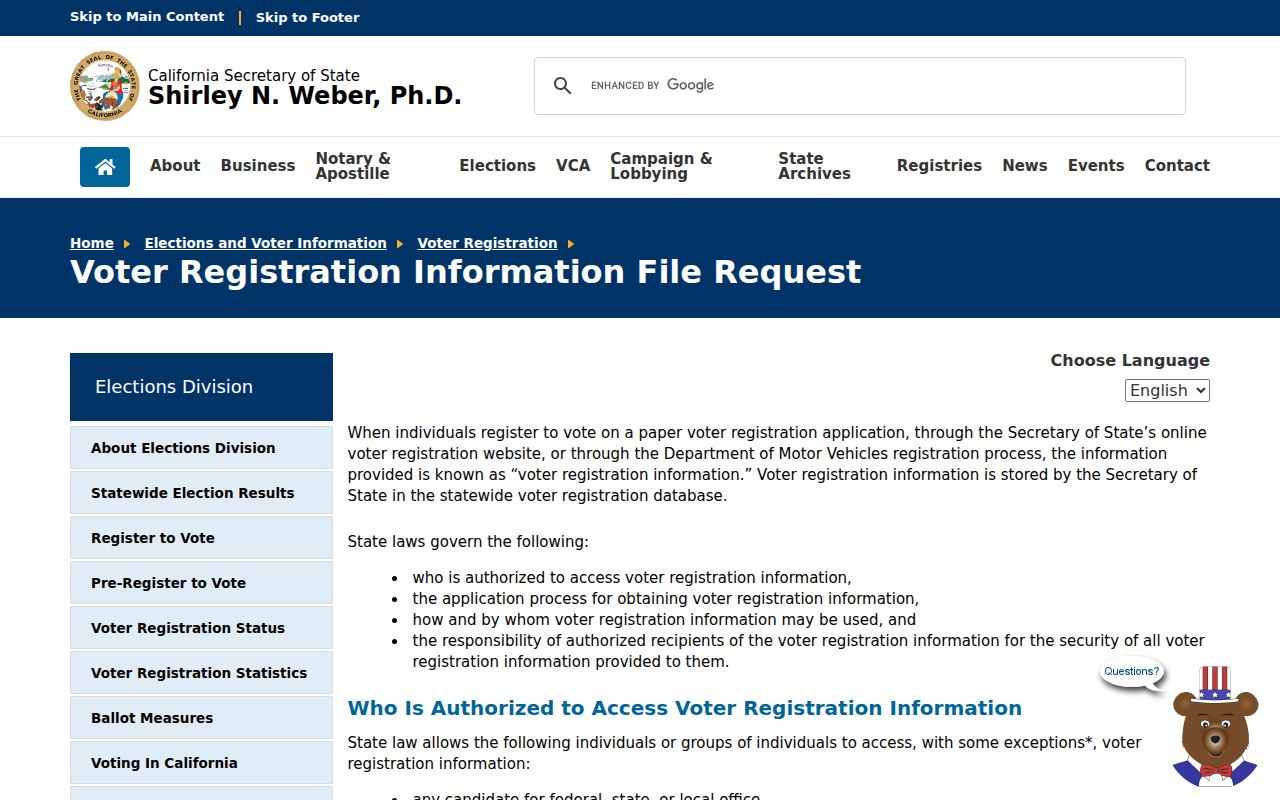
That distinction is vital for Livermore research because the state reviews both the applicant and the proposed use before releasing data. Follow the documented request sequence:
- Choose statewide, county, district, or up to ten specific voter records. For each specific voter, give full name, date of birth, county of residence, and residence address.
- State the permitted purpose in detail. Identify the applicant and any beneficiary organization, then explain how the data will remain secure and confidential.
- Sign the paper application with an original signature. Include a clear copy of a current driver license or state ID and the required fee.
- Mail it to the Secretary of State at the address on the current form. Emailed and faxed applications are not accepted.
The state processes requests in the order received. The documented review period is 7 to 14 business days after receipt, not a promise of same-day access.
Livermore Voter File Application
The form asks for the applicant's full name, phone, email, business address, and a different mailing address when needed. A request made for another business, organization, or committee also identifies that beneficiary. The applicant selects an organization type and purpose, writes a detailed account of the intended use and security plan, chooses location and data options, and completes the agreement and signature page.
Choices include inactive registration records, available voting history, and precinct-to-district data. The applicant also supplies shipping details when physical data is requested. Available delivery choices on the captured form include U.S. mail, pickup at the Secretary of State office, and secure FTP. Other shipping methods require the proper labels, forms, and payment.
Fees and Secure Delivery
The state application lists $15 per thousand records, capped at $100. A specific voter record costs $30 per record, also capped at $100, with no more than ten specific records on one application. The Secretary of State request page separately lists $100 as the statewide application fee. County request fees vary, so an Alameda County applicant should confirm the current county charge before filing.
Large state, county, or district extracts are distributed on encrypted DVD as three plain-text, tab-delimited files: voter data, voting history, and district data. A tab-delimited file stores each row's fields with tab characters so database or spreadsheet software can import them. Specific-voter results arrive through an encrypted WinZip email attachment. Once the data has been extracted and sent, the fee is not refunded.
Note: Keep the encrypted delivery and every working copy secured for the full time that approved voter data remains in use.
Livermore Election Data Geography
The Alameda County Registrar of Voters eData portal offers a different kind of access. It publishes aggregate registration totals, party and language tables, historical charts, and maps. It does not replace the personal state-status check or the voter-file application. Its filters and map layers place Livermore voters within overlapping congressional, legislative, supervisorial, education, special-district, city, city-council, and consolidated-precinct geography.
This county view is best for civic context. A researcher can review countywide registration patterns or election boundaries without seeking person-level data. The research capture also found registration-history views and dozens of map layers, plus current election and vote-by-mail reporting. Since dashboard numbers change, use the live portal for present totals rather than treating a captured figure as permanent.
The Alameda County registration page is the local route into the state voter process.
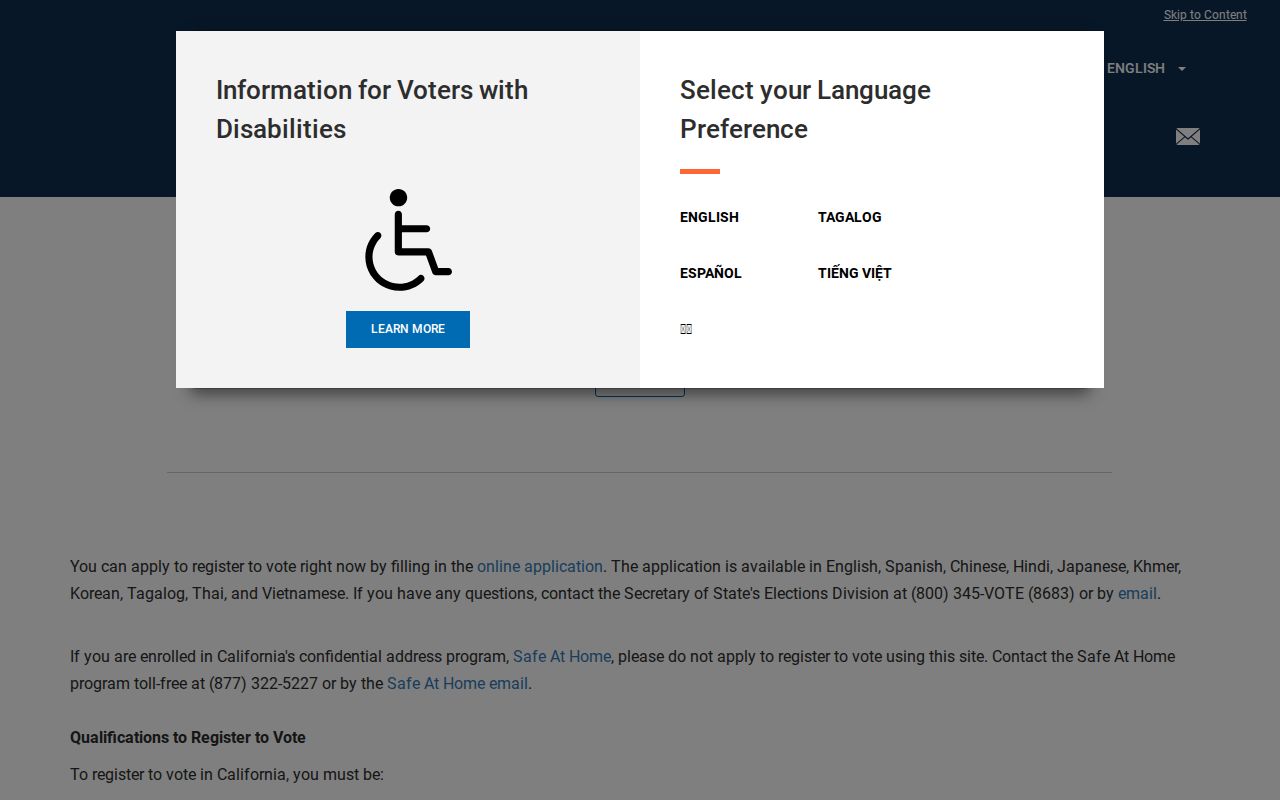
It confirms that Livermore registration administration sits within Alameda County even though California supplies the online registration and status systems.
Voter Data Use Penalties
Approval is tied to the stated purpose. The California application bars unapproved use, commercial, advertising, or marketing use, harassment of any voter or household, unauthorized sharing or transfer, and leaving the file unsecured online or offline. The applicant also agrees not to sell, lease, loan, or deliver possession except as California Code of Regulations section 19005 allows, and to maintain security under section 19012.
A violation can be a misdemeanor with significant fines under Elections Code section 18109. Suspected misuse can be reported to the California Secretary of State Elections/VoteCal Help Desk at votecalhelp@sos.ca.gov or (888) 868-3225, as listed on the application. The safe rule is simple: use only the approved data, for only the approved purpose, and do not expose or pass it to someone else without the required new application and written approval.
Historical Livermore Voter Registers
Current voter status tools are poor fits for family history. The California State Archives local-records collection identifies Alameda County Great Registers among its historical holdings. These registers are predecessors to modern voter rolls and commonly record a voter's name, age, nativity, occupation, residence, registration facts, and naturalization details for a foreign-born voter. They reflect the eligibility rules of their own era and should not be read as complete lists of all adults.
For a past Livermore resident, pair a Great Register with the Livermore Public Library newspaper indexes, Livermore Heritage Guild tax records and business directories, or Alameda deed sources. Those records can distinguish people with the same name and connect an old residence or trade to a specific person. Historical registers are archival evidence, while the current file is restricted operational data. Keeping those channels separate avoids both a dead end and a privacy mistake.